
How Refunds & Chargebacks Work
We want every customer to understand how refunds are actually processed — because the way money moves behind the scenes isn’t always obvious, and it directly affects how quickly you get your funds back. This becomes a special process when afterpay and refunds for the same transaction exist at the same time.
How a normal refund and afterpay refunds work
When we approve a refund, we initiate it through our payment processor, Square. From there, funds are pushed back through to your original payment method — whether that’s a debit or credit card, or a service like Afterpay. In a normal case, with no dispute involved, this is usually the fastest way for you to get your money back.
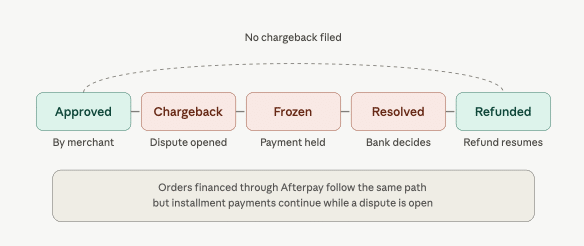
What happens when a chargeback is filed
A chargeback is a dispute filed directly with your bank or payment provider, separate from anything we do on our end. Once a chargeback is filed:
- The payment processor freezes the disputed funds while the dispute is under review.
- We are not able to issue a refund for that transaction until the dispute is resolved — even if we’ve already started processing one.
- The timeline for resolution is set by the processor, not by us. We don’t control how long this takes.
Important: if we have already begun processing your refund and a chargeback is filed on the same transaction, the chargeback doesn’t speed things up — it interrupts the refund that was already underway and adds an additional review process on top of it.
If you’re waiting on a refund
If a refund is taking longer than expected, the fastest path is usually to contact us directly rather than filing a dispute. We’re often able to offer alternatives — for example, sending funds through a direct payment method — while a standard refund is still processing. Filing a chargeback while a refund is already in progress typically extends the timeline rather than shortening it.
Orders placed through Afterpay and Refunds
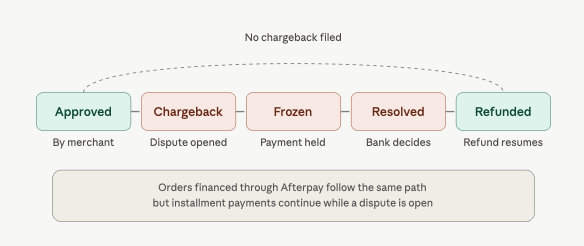
If your order was financed through Afterpay, there’s an added layer to be aware of:
- Afterpay is a separate contract between you and Afterpay, not us. We don’t control its billing schedule.
- If a chargeback or dispute is filed on an Afterpay-financed order, your installment payments to Afterpay continue on their normal schedule while the dispute is under review — that schedule doesn’t pause just because a dispute is open.
- Once our refund is finalized on our end, Afterpay handles returning your funds and closing out your installment contract. That part of the process happens on Afterpay’s timeline, not ours.
Why can’t you just send my money by Cash App, Venmo, or Zelle?
Refunds are required to go back through the original payment method — sending money a different way can actually make a dispute worse, not better.
Here’s why:
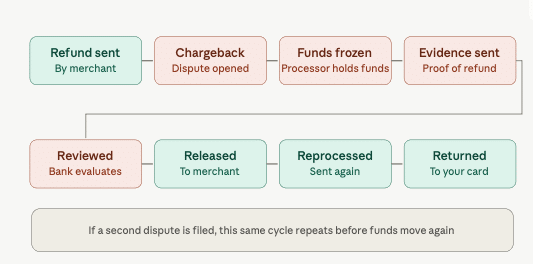
- It creates a duplicate payment. If we send funds through Cash App or a similar app while a dispute is still open, and then also complete the required refund through the original payment method, that’s two payments for one order. The processor and bank need to see a refund processed through the same rails the original charge went through in order to close out the dispute — a separate app payment doesn’t count as that refund.
- It can complicate resolution rather than speed it up. If a dispute continued after a separate payment was sent, it can result in needing to reverse or reclaim one of the two payments, which adds an extra step rather than resolving things faster.
- It’s required for compliance. Processors require the refund to be issued the same way the original payment was received. This isn’t optional or up to us.
That said — while a refund is delayed by a dispute, we may still offer to send funds directly through an app like Cash App as a good-faith gesture, in addition to the required refund. That’s meant to get money to the customer sooner, not to replace the formal refund — the dispute still has to close out through the original payment method. If a refund is processed outside of the dispute process you will owe funds back to us if a double refund is issued. We will dispute a refund through the payment processor if we issue an external refund and provide proof of that completed refund.
Leave a Reply